一枚实实在在的建中通宝
一 把这枚唯一现世的建中通宝摆出来
.形制
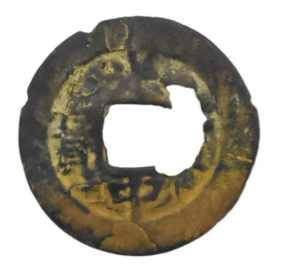
直径 23.7毫米,厚薄(基本均匀)约 0.4—0.5毫米,重量 1.05克(现重量)。
注:钱币穿口的右边缘有一处原始缺损,经目测估算,缺损部分约重0.05克,由此估计其原始完整状态下的克重约为1.1克。
.阔缘
观其形制,最醒目的莫过于阔缘特征。在23.7毫米直径的钱体之上,缘阔竟达到3.3毫米,远超普通建中通宝的缘宽比例。这般宽阔的外郭,不仅让钱币轮廓更显周正大气,也让钱文与地章的界限愈发清晰分明。
.直读
钱文采用直读方式,‘建’字居于上,‘中’字列于下,‘通’字排布于右,‘宝’字坐落于左。
.文与字
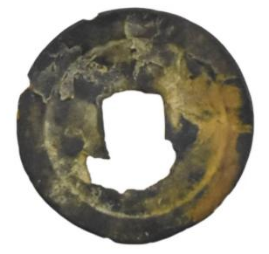
钱文风格颇具特色,较真来看,‘建’、‘通’、‘宝’三字与‘中’字反差格外鲜明。‘建’‘通’‘宝’三字为隶书,笔画细、浅,文字模糊(漫漶、晦漫);唯独‘中’字显得十分醒目,字形硕大粗壮,上顶穿郭,下插缘郭,存在感极强。钱币背面无任何文字、记号。
.锈色
通体正背两面呈深墨绿色,下半部分略呈浅黄锈色,绿锈与黄锈之间过渡自然。锈迹自然入骨,色泽老辣,(毫无酸咬浮锈),尽显岁月沉淀的自然质感。
.钱面
钱币的天章、地章之上,布满不规则的纹条与斑驳色块,没有规整划一的精工痕迹,反而透着一股历经千年的艰辛苍古之气,尽显质朴本真。
.穿口缺损
穿口右向内墙存在一处明显缺口,缺损范围较大,从右穿孔过墙延伸至‘通’字的大部分区域。经精准卡尺比对测算,缺口的宽约为3毫米,高约为7.6毫米,抽象形状酷似“台湾岛”。所幸这一缺损并未对钱面主体识读造成过大影响,‘通’字尚存小半边轮廓,放大后依旧可以依稀辨认。
..核心细节解读
① 直径尺码
23.7毫米的直径,在整个建中通宝序列里,堪称豪横的大钱尺码,显超常规形制(常见直径22.5-23毫米),一眼便能看出与众不同。
② 阔缘标识
阔缘是“大钱”的重要标识,凡是阔缘的形制,自显不凡。
③ 直读制式
对比各有关博物馆现存的建中通宝小平钱均为“旋读”,这枚钱币的直读制式就显得格外特殊。(直读本身很平常,但对比其他一众“小老弟”的旋读,咱就显得高高在上,唯我独高。)
④ 凸显‘中’字
‘中’字字形兀大粗壮,尽显尊贵姿态。这个‘中’字寓意心系中央,更与忠勇的‘忠’字通融,呼应边疆军民坚守故国的赤诚决心。
⑤ ‘建’字少横
钱文‘建’字少横的独特写法,并非随意缺笔,而是完全符合建中通宝西域绝境铸币的工艺特征,与出土文献记载高度契合。参见公博(GBCA)钱币评级机构(2025年建中通宝专项鉴定指南)
真品建中通宝核心特征:
1. 铜质为暗红或褐红,含杂志,手感轻飘;
2. 文字模糊,'建'字多缺横,'通'字走之底常简化;
3. 包浆自然入骨,锈色老辣,无酸咬浮锈;
4. 无任何背文,尺寸严格≤23mm。
新特征为铜质暗红或褐红、含杂质、手感轻飘、文字模糊,且‘建’字多缺横、‘通’字走之底常简化——这枚钱币的细节与上述标准完全吻合,是其源自中唐边疆铸币的直接佐证。
综上,本品的突出特点,一是形制大,二是直读,三是显‘中’。大、直、‘中’、阔缘四重叠加,本枚建中通宝为“大钱”(那到底是啥大钱呢?值百、值千?无从追问),大钱本身就是为解决钱荒而生的。
Put out the only Jianzhong Tongbao in the world.
. Structure
The diameter is 23.7 mm, the thickness (basically uniform) is about 0.4-0.5 mm, and the weight is 1.05 grams (current weight).
Note: There is an original defect on the right edge of the coin penetration. According to visual measurement, the weight of the defective part is about 0.05 grams, from which it is estimated that its gram weight in its original complete state is about 1.1 grams.
. Kuoyuan
Looking at its shape, the most eye-catching thing is the wide edge feature. On the money body with a diameter of 23.7 mm, the edge width actually reaches 3.3 mm, far exceeding the margin width ratio of ordinary Jianzhong Tongbao. Such a wide outer wall not only makes the outline of the coin more upright, but also makes the boundary between Qianwen and Dizhang clearer.
. Straight reading
Qianwen adopts a direct reading method. The word 'Jian' is at the top, the word 'Middle' is at the bottom, the word 'Tong' is arranged on the right, and the character 'Bao' is located on the left.
. Text and words
The style of Qianwen is quite distinctive. From a more serious point of view, the three characters of "build", "Tong" and "Bao" are particularly contrasting with the words "Zhong". The three characters of "Tong" and "Bao" are Lishu. The strokes are thin and shallow, and the text is vague (long and obscure); only the character "middle" is very eye-catching, with large and thick glyphs, with a strong sense of existence. There are no words or symbols on the back of the coins.
. Rust colour
The front and back of the whole body are dark dark green, and the lower half is slightly yellow rusty, and the transition between green rust and yellow rust is natural. The rust is natural to the bone, and the colour is old and spicy, (no acid bite and rust), showing the natural texture of the years.
. Money noodles
The heavenly and underground seals of the coins are full of irregular stripes and mottled colour blocks. There are no regular and uniform traces of fine workmanship. Instead, they show a sense of hardships and ancientity after thousands of years, showing the simplicity and authenticity.
. Piercing defect
There is an obvious notch on the right side of the inner wall of the penetration, and the defect range is large, extending from the right perforation through the wall to most of the area of the word 'through'. According to the precision calliper comparison, the width of the notch is about 3 mm and the height is about 7.6 mm, and the abstract shape is very similar to "Taiwan Island". Fortunately, this defect did not have too much impact on the reading of the main body of the money surface. The word 'Tong' still has a small half-edge outline, which can still be vaguely recognised after enlargement.
.. Interpretation of core details
1 diameter size
With a diameter of 23.7 mm, in the whole Jianzhong Tongbao sequence, it can be called the size of the big money, showing an extraordinary shape (common diameter 22.5-23 mm), which can be distinguished at a glance.
2 Wide edge logo
The broad edge is an important sign of "big money". Any form of the broad edge is extraordinary.
3 Direct reading system
Compared with the existing Jianzhong Tongbao Xiaoping coins in various relevant museums, the direct reading system of this coin is particularly special. ( Direct reading itself is very common, but compared with the spin reading of other "little brothers", we seem to be superior, but I am the only one.)
4 Highlight the word 'middle'
The word 'Chinese' is large and strong, showing a noble attitude. The word "middle" implies the centre of the heart, and is more flexible with the word "loyalty" of loyalty, echoing the sincere determination of the border military and civilians to stick to the home country.
5 The word 'build' is less horizontal
The unique writing style of the word "Jian" in Qianwen is not a random lack of strokes, but fully conforms to the technological characteristics of Jianzhong Tongbao West Region Desperate Coin Minting, which is highly consistent with the excaved documents. Refer to the GBCA Coin Rating Agency (Special Identification Guide for Jianzhong Tongbao in 2025)
The core characteristics of genuine Jianzhong Tongbao:
1. Copper is dark red or brownish red, containing magazines, and feels light;
2. The text is vague, the word 'build' is often missing horizontal, and the bottom of the word 'tong' is often simplified;
3. The pulp naturally enters the bones, the rust colour is old and spicy, and there is no acid bite and rust;
4. There is no backing, and the size is strictly ≤23mm.
The new characteristics are copper dark red or brown red, containing impurities, light to the touch, vague text, and the word "build" is often horizontal, and the bottom of the word "through" is often simplified - the details of this coin completely coincide with the above standards, which is a direct proof that it comes from the mint of coins in the Middle and Tang Dynasties.
In summary, the outstanding features of this product are, firstly, the shape is large, secondly, it is direct reading, and thirdly, it shows 'middle'. Big, straight, 'medium' and wide edge overlap, this piece of Jianzhong Tongbao is "big money" (what kind of big money is that? Worth a hundred or a thousand? There is no way to ask), big money itself is born to solve the money shortage.
二 掀开历史一页
安史之乱后的大唐,已然褪去“贞观之治”“开元盛世”的荣光,藩镇割据加剧,边疆烽火未息,西域与中原的联系在战乱与吐蕃侵扰中彻底隔绝,安西、北庭都护府陷入孤悬域外42年之久的绝境。建中年间(公元780年—783年),德宗李适在位,王朝虽力图重整秩序,却深陷内忧外患的困境:内地藩镇叛乱此起彼伏,西域则被吐蕃重兵围困,丝绸之路彻底中断,边疆军民与中原失联,粮草、物资彻底断绝,生存与坚守愈发艰难。
正是在这般绝境之下,建中通宝应运而生。它并非长安京畿之地的主流铸币,而是安西、北庭都护府在孤悬无援的情况下,为维系当地军政运转、保障军民基本生活而铸造的钱币。彼时的西域,铸币条件极度简陋,缺乏统一的模具与充足的原料,这也造就了建中通宝“形制偏小、工艺略显粗率”的特质——正如这枚钱币细浅的钱文、不规则的钱面,皆烙印着绝境铸币的仓促与坚韧。
它没有盛唐钱币的雄浑规整,却以朴素的形态承载着厚重的历史:既是中唐边疆治理崩坏后的真实写照,也是中原文化在西域绝境中延续的物证,更是无数戍边将士、平民百姓在隔绝无援的困境中,坚守唐朝正朔、不离不弃的忠勇精神的凝结。一枚小小的古泉,恰似一扇窗,掀开了中唐历史的褶皱,让我们得以窥见那个时代边疆军民在绝境中坚守的悲壮与赤诚。
Second, open a page of history
After the Anshi Rebellion, the Tang Dynasty had faded the glory of "the rule of Zhenguan" and "the prosperity of Kaiyuan". The division of clans and towns intensified, and the border beacons had not subsided. The connection between the western region and the Central Plains was completely isolated in the war and the invasion of Tibet. Anxi and Beiting Duhufu fell into a desperate situation outside the territory for 42 years. During the Jianzhong period (780-783 A.D.), Emperor Dezong Li Shi reigned. Although the dynasty tried to reorganise order, it was deeply in the dilemma of internal worries and external dangers: the rebellions in the mainland occurred one after another, the western region was besieged by Tibetan heavy troops, the Silk Road was completely interrupted, the border military and civilians lost contact with the Central Plains, food, grass and materials were completely cut off, and survival and It is more and more difficult to stick to it.
It is under such a desperate situation that Jianzhong Tongbao was born. It is not the mainstream coinage of Chang'an and Gyeonggi, but the coins minted by Anxi and Beiting Duhufu to maintain the local military and political operation and ensure the basic livelihood of the military and civilians under the condition of being helpless. At that time, the conditions for coinage in the western region were extremely simple, and there was a lack of unified moulds and sufficient raw materials, which also created the characteristics of Jianzhong Tongbao's "small shape and slightly crude technology" - just like the thin and irregular money of this coin, all branded the hasty and tenacity of the desperate coinage.
It does not have the majesty and regularity of the Tang Dynasty coins, but carries a heavy history in a simple form: it is not only a true picture after the collapse of the border governance of the Middle and Tang Dynasties, but also the physical evidence of the continuation of the Central Plains culture in the desperate situation of the western region. It is also the loyalty of countless frontier soldiers and civilians in the dilemma of isolation and helplessness, sticking to the Tang Dynasty. The condensation of bravery. A small ancient spring, just like a window, opened the folds of the history of the Middle and Tang Dynasties, allowing us to glimpse the tragedy and sincerity of the frontier soldiers and civilians in that era.
三 重大考古记录、发现及相关文献
(一)重大关键的考古发现与馆藏记录
1. 新疆库车(古龟兹):20世纪80年代以来,当地考古发掘多次出土建中通宝,与大历元宝等中唐边疆铸币同出,证实建中年间安西都护府在隔绝中原的绝境下仍铸币维系运转。
2. 甘肃敦煌莫高窟藏经洞:遗存少量建中通宝实物及相关文书,佐证其用于边境军民粮草兑换、小额贸易的流通功能。
3. 国家博物馆:馆藏1枚品相完好的建中通宝,为唐代西域绝境铸币标准器,是国内古钱币鉴别核心参照标本。
4. 新疆维吾尔自治区博物馆:馆藏1枚出自库车安西都护府遗址的建中通宝,磨损残缺,是边疆绝境铸币的典型实物。
5. 阿克苏地区文博院:馆藏1枚1992年出土于通古斯巴什古城的建中通宝,与大历元宝同出,见证安西守军坚守西域的历史。
6. 扬州博物馆:馆藏半枚残缺建中通宝,印证其曾流通至江南商业重镇。
(二)现代古文物工作者、古钱币研究者的相关文献论断
1. 王永兴(唐史专家):《唐代前期的西域经略与边疆政策》指出,建中通宝是安西、北庭孤悬西域42年的铸币实物,是研究边疆军民坚守史的核心资料。
2. 戴志强(古钱币学家):《中国古钱币通论》考证,建中通宝铸于安西都护府,工艺简陋却坚守唐钱制式,阔缘版式尤为罕见。
3. 黄文弼(考古学家):《西域考古记》记录西域考古发现建中通宝的经过,明确其为边镇孤悬无援时的自救铸币。
4. 李锦绣(边疆史学者):《唐代边疆铸币研究》提出,建中通宝见证中原与西域血脉相连,其历史价值远超普通唐钱。
5. 马定祥(钱币学家):校注《古泉汇考》时补充考古发现,强调建中通宝“孤悬域外42载”的核心特质,是收藏与研究的珍品。
(三)全国核心博物馆馆藏统计(截至2025年)
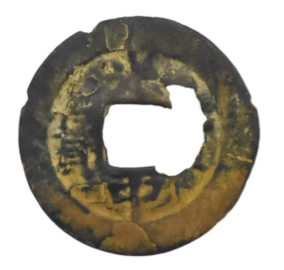
据公开考古报告及馆藏登记,全国馆藏只有8枚半,(没有出现直径达到23.7的、阔缘的、直读的、兀‘中’的建中通宝)。分布于北京、西安、乌鲁木齐、阿克苏、扬州等地核心博物馆,涵盖京城、边疆、江南等区域,完整呈现其流通轨迹与“铸期短、存世稀、分布散”的特质。
III Major archeological records, discoveries and related documents
(I) Major and key archeological discoveries and collection records
1. Xinjiang Kuche (Guguizi): Since the 1980s, local archeological excavations have excavated Jianzhong Tongbao many times, which have been minted with Dali Yuanbao and other border coins in the Middle and Tang Dynasties, confirming that during the Jianzhong period, the Anxi Duhufu was still minting and maintaining the operation under the desperate situation of isolation from the Central Plains.
2. Mogao Grottoes in Dunhuang, Gansu Province: A small number of Jianzhong Tongbao physical objects and related documents remain, which proves its circulation function for border military-civilian grain and grass exchange and small-scale trade.
3. National Museum: The museum has a complete Jianzhong Tongbao, which is the standard instrument for minting coins in the western region of the Tang Dynasty, and is the core reference specimen for the identification of ancient coins in China.
4. Xinjiang Uygur Autonomous Region Museum: The museum's collection is a Jianzhong Tongbao from the ruins of Kuche Anxi Duhufu. It is worn and incomplete. It is a typical physical object of border coins.
Five. Aksu Regional Cultural Museum: A collection of Jianzhong Tongbao unearthed in the ancient city of Tonggusbash in 1992, which was released together with the Dali Yuanbao, witnessing the history of the Anxi guards sticking to the western region.
6. Yangzhou Museum: Half of the incomplete Jianzhong Tongbao in the museum's collection proves that it was circulated to the important commercial town in the south of the Yangtze River.
(II) Relevant literature assertions of modern ancient cultural relics workers and ancient coin researchers
1. Wang Yongxing (Tang History Expert): "Western Strategy and Border Policy in the Early Tang Dynasty" pointed out that Jianzhong Tongbao is a 42-year-old coinage coinage in Anxi and Beiting, which is the core material for studying the history of military and civilians in the frontier.
2. Dai Zhiqiang (ancient coinologist): "The General Theory of Chinese Ancient Coins" verified that Jianzhong Tongbao was cast in Anxi Duhufu. The craft is simple but adheres to the Tang Dynasty money system, and the wide-edged layout is particularly rare.
3. Huang Wenbi (archaeologist): "Archeology of the Western Regions" records the archeological discovery of Jianzhong Tongbao in the Western Regions, and makes it clear that it is a self-saving coin when the border town is alone.
4. Li Jinxiu (Border History Scholar): "Research on Frontier Coinage in the Tang Dynasty" proposed that Jianzhong Tongbao witnessed the bloodline connection between the Central Plains and the western region, and its historical value far exceeded that of ordinary Tang coins.
Five. Ma Dingxiang (currency scientist): When the correction annotation "Guquan Huikao" supplemented the archeological discovery, emphasising the core characteristics of Jianzhong Tongbao's "lonely hanging outside the territory for 42 years", which is a treasure for collection and research.
(3) Collection statistics of national core museums (as of 2025)
According to the public archeological report and the registration of the collection, there are only 8 and a half pieces in the national collection, (there is no Jianzhong Tongbao with a diameter of 23.7, wide edge, direct reading, and "middle"). It is distributed in the core museums of Beijing, Xi'an, Urumqi, Aksu, Yangzhou and other places, covering the capital, the border, the south of the Yangtze River and other regions, fully presenting its circulation trajectory and the characteristics of "short casting period, rare existence, and scattered distribution".
四 权威专家鉴评
经鉴定泰斗朱老师对这枚建中通宝进行了全方位、高精度的专业鉴评,当即明确断言:“大开门!这枚铜钱就是建中通宝。”
话音刚落,在场有人提出问:“这个‘建’字看着和常见的写法不太一样,这真的是‘建’字吗?”。朱老师指着钱文上的“建”字,耐心解惑:“是建字,我看就是建字。建中通宝的‘建’字是这种写法。”末了,专家还感慨道:“钱币虽小,乾坤乃大。”当时多人在场,一同见证。
IV. Evaluation by authoritative experts
After appraisal, Mr. Taidou Zhu conducted an all-round and high-precision professional evaluation of this Jianzhong Tongbao, and immediately clearly asserted: "Open the door! This copper coin is Jianzhong Tongbao.
As soon as the words fell, someone present asked, "The word 'build' looks different from the common way of writing. Is it really the word 'build'?" Mr. Zhu pointed to the word "Jian" on Qianwen and patiently solved the puzzle: "It's the word Jian, I think it's the word Jian. This is the way to write the word 'jian' in Jianzhong Tongbao. At the end, the expert sighed, "Although the coins are small, the universe is big." At that time, many people were present and witnessed together.
五 结语
一钱虽小,可载山河。 持此‘建中',如见当年“威武郡王” ;持此‘建中',如握中唐晚期西域军民绝守四十二年的坚韧忠魂。
Five Conclusions
Although a penny is small, it can carry mountains and rivers. Holding this "Jianzhong" is like seeing the "King of Weiwu County" in those years; holding this "Jianzhong" is like holding the tenacity and loyalty of the military and civilians in the western region in the late Tang Dynasty for 42 years.
郑重声明:本文版权归原作者所有,转载文章仅为传播更多信息之目的,如作者信息标记有误,请第一时间联系我们修改或删除,多谢。