吴榖祥款画
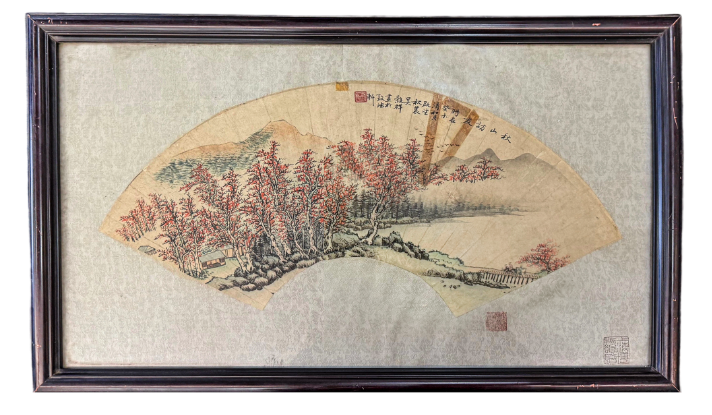
扇面作为中国传统书画的独特载体,以其精巧形制与文人雅趣,成为明清以来书画艺术中极具魅力的品类。这幅署款 “吴榖祥” 的《秋山访友》扇面画,不仅是晚清海派山水画的典型代表,更承载着画家对传统山水文脉的继承与个人艺术语言的表达,在咫尺之间铺展了一幅充满诗意的江南秋景。
As a unique carrier of traditional Chinese calligraphy and painting, fan paintings have become a highly charming category in the art of calligraphy and painting since the Ming and Qing dynasties due to their exquisite form and literati elegance. This fan painting titled Visiting Friends in Autumn Mountains, signed by Wu Guxiang, is not only a typical representative of late Qing Shanghai School landscape painting, but also carries the painter's inheritance of the traditional landscape context and expression of his personal artistic language, unfolding a poetic Jiangnan autumn scene within a small space.
吴榖祥,字秋农,号秋圃老农,浙江嘉兴人,是晚清海上画派中坚守文人画传统的重要画家。他早年研习仕女画,取法改琦、费丹旭等名家,画风清丽婉约;中年后转向山水画,远师明代吴门画派的沈周、文徵明,近法清代画家戴熙,形成了苍劲秀逸、设色清丽的个人风格。在清末画坛崇尚纵横草率风气的背景下,吴榖祥始终恪守文人画的笔墨法度,以细腻笔触与清雅意境独树一帜,其作品被学者俞樾誉为 “神品”,足见当时艺坛对其艺术成就的高度认可。
Wu Guxiang, styled Qiunong and also known as Qiupu Laonong, was a native of Jiaxing, Zhejiang, and an important painter of the late Qing Shanghai School who adhered to the tradition of literati painting. In his early years, he studied figure painting of ladies, learning from famous painters such as Gai Qi and Fei Danxu, with a delicate and graceful style; in his middle age, he turned to landscape painting, learning from Shen Zhou and Wen Zhengming of the Ming Dynasty Wu School in the distant past, and from the Qing painter Dai Xi in the recent past, forming a personal style that is vigorous, elegant, and clear in color. Against the backdrop of the late Qing painting circle's preference for a bold and careless style, Wu Guxiang always adhered to the brushwork rules of literati painting, standing out with delicate brushstrokes and elegant artistic conception. His works were praised as "divine works" by the scholar Yu Yue, which fully demonstrates the high recognition of his artistic achievements in the art circle at that time.
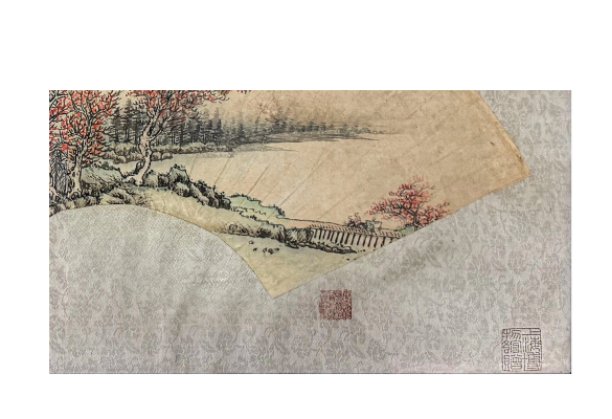
《秋山访友》扇面以浅绛设色与水墨晕染相结合,在扇形的弧形空间里构建了层次丰富的山水意境。画面近景处,几株红枫错落生长,枝干以苍劲墨线勾勒,叶片则以朱砂点染,明艳而不俗,尽显秋日山林的绚烂生机;树下掩映着几间茅舍,屋舍简洁雅致,似有隐士隐居其间,传递出 “结庐在人境,而无车马喧” 的隐逸情怀。中景处,一条木桥横跨溪岸,桥上有策杖而行的文人,正向着山林深处走去,点明了 “访友” 的主题,也为静谧的山水增添了一丝人文温度;溪水蜿蜒流淌,以淡墨留白表现,与岸边的山石、树木形成虚实对比,让画面更具通透感。远景处,山峦以淡墨晕染,轮廓模糊朦胧,营造出 “远山无墨千秋画” 的悠远意境,与近景的明艳秋红形成冷暖、虚实的视觉呼应,使整个画面在有限空间里延伸出无限的诗意想象。
Visiting Friends in Autumn Mountains combines light crimson coloring and ink wash to construct a layered landscape artistic conception within the arc-shaped space of the fan. In the foreground of the painting, several red maple trees grow scattered, with their branches outlined by vigorous ink lines and their leaves dotted with cinnabar, bright but not vulgar, fully showing the brilliant vitality of the autumn mountain forest; under the trees are several thatched cottages, simple and elegant, as if hermits are living in seclusion, conveying the reclusive sentiment of "building a cottage in the human world, but without the noise of carriages and horses". In the middle scene, a wooden bridge spans the stream bank, on which a literati walking with a cane is walking towards the depths of the mountain forest, pointing out the theme of "visiting friends" and adding a touch of human warmth to the quiet landscape; the stream winds and flows, expressed by light ink and blank space, forming a virtual-real contrast with the rocks and trees on the bank, making the painting more transparent. In the distant view, the mountains are rendered with light ink, with blurred and hazy outlines, creating a distant artistic conception of "distant mountains without ink are a thousand-year painting", forming a cold-warm and virtual-real visual echo with the bright autumn red in the foreground, allowing the entire painting to extend infinite poetic imagination within a limited space.
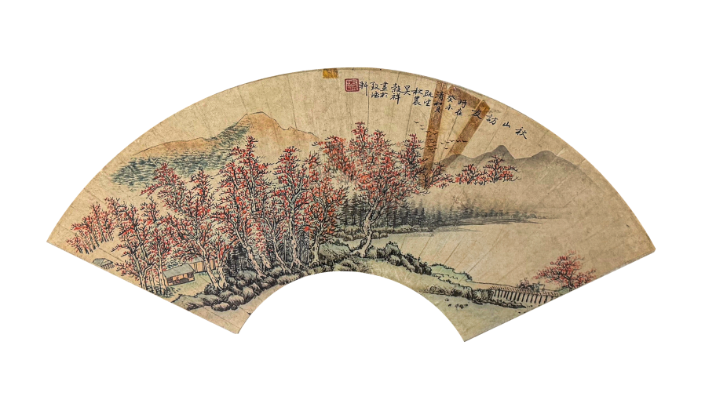
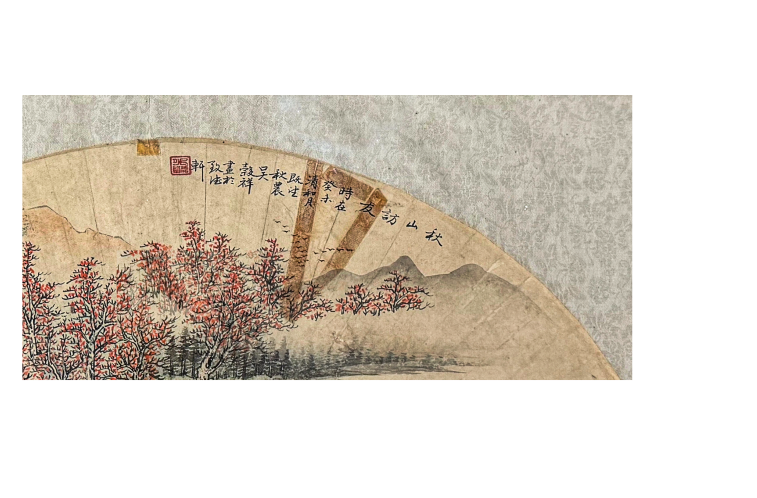
从笔墨技法来看,这幅扇面充分体现了吴榖祥对传统山水技法的娴熟掌握。画中树木的枝干以中锋行笔,线条苍劲有力,既有文徵明的秀雅,又不失戴熙的苍浑;山石则以短披麻皴与点苔结合,表现出江南山石温润秀美的质感,避免了北派山水的雄奇险峻,更贴合江南水乡的地域气质。设色上,以淡赭石、花青晕染山石,以朱砂点染枫叶,色彩清丽淡雅,既保留了文人画 “淡彩而神理俱足” 的审美追求,又通过秋红的点缀,让画面在清雅中透出一丝暖意,契合了 “秋山访友” 的温情主题。题款 “秋山访友,时在癸未清和月,既生吴榖祥画于致德轩” 清晰记录了创作时间与地点,旁附的印章则进一步印证了作品的身份,这些题跋与印章不仅是书画作品的重要组成部分,更成为后世研究吴榖祥艺术生涯与创作脉络的珍贵史料。
From the perspective of brushwork techniques, this fan painting fully reflects Wu Guxiang's proficient mastery of traditional landscape techniques. The branches of the trees in the painting are drawn with the central stroke, with vigorous and powerful lines, which have both the elegance of Wen Zhengming and the vigor of Dai Xi; the rocks are combined with short hemp-fiber texture cracking and moss dots, showing the gentle and beautiful texture of Jiangnan rocks, avoiding the magnificence and steepness of Northern School landscapes, and more in line with the regional temperament of Jiangnan water towns. In terms of coloring, the rocks are rendered with light ochre and indigo, and the maple leaves are dotted with cinnabar. The colors are clear and elegant, not only retaining the aesthetic pursuit of literati painting that "light color is sufficient for spirit and reason", but also making the painting reveal a touch of warmth in elegance through the embellishment of autumn red, in line with the warm theme of "visiting friends in autumn mountains". The inscription "Visiting Friends in Autumn Mountains, painted in the Qinghe month of Guiwei year by Jisheng Wu Guxiang at Zhide Xuan" clearly records the creation time and place, and the attached seal further confirms the identity of the work. These inscriptions and seals are not only an important part of calligraphy and painting works, but also become precious historical materials for later generations to study Wu Guxiang's artistic career and creation context.
在晚清海派绘画的发展脉络中,吴榖祥的《秋山访友》扇面具有特殊的意义。海派绘画以商业化为特征,多迎合市民审美趣味,而吴榖祥却始终坚守文人画的精神内核,将传统山水的隐逸情怀与江南地域的审美特质相结合,在扇面这一 “小品” 形制中,实现了 “以小见大” 的艺术表达。这幅作品既没有宏大的山水构图,也没有繁复的笔墨技巧,却在咫尺之间传递出中国文人 “仁者乐山,智者乐水” 的精神追求,以及 “访友” 这一充满人情味的社交理想,让观者在欣赏笔墨之美的同时,也能感受到晚清文人在动荡时代中对精神净土的向往与坚守。
In the development context of late Qing Shanghai School painting, Wu Guxiang's Visiting Friends in Autumn Mountains fan painting has special significance. Shanghai School painting is characterized by commercialization and mostly caters to the aesthetic taste of citizens, but Wu Guxiang always adhered to the spiritual core of literati painting, combining the reclusive sentiment of traditional landscape with the aesthetic characteristics of Jiangnan region, and realizing the artistic expression of "seeing the big from the small" in the "sketch" form of fan painting. This work has neither a grand landscape composition nor complicated brushwork skills, but conveys the spiritual pursuit of Chinese literati that "the benevolent enjoys mountains, and the wise enjoys water" and the social ideal of "visiting friends" full of human touch within a small space, allowing viewers to feel the yearning and persistence of late Qing literati for spiritual pure land in the turbulent era while appreciating the beauty of brushwork.
如今,当我们凝视这幅历经岁月沉淀的扇面画时,不仅能欣赏到吴榖祥精湛的笔墨技艺与清雅的艺术意境,更能触摸到晚清文人画在时代变局中的坚守与传承。它以扇为媒,将秋山的绚烂、访友的温情与文人的风骨凝聚于一纸之上,成为中国传统山水画中 “小而美” 的经典范例,也让我们在当代快节奏的生活中,重新感受到那份来自笔墨与山水之间的宁静与诗意。
Today, when we gaze at this fan painting that has experienced the precipitation of years, we can not only appreciate Wu Guxiang's exquisite brushwork skills and elegant artistic conception, but also touch the persistence and inheritance of late Qing literati painting in the changes of the times. With the fan as the medium, it condenses the brilliance of autumn mountains, the warmth of visiting friends, and the integrity of literati on a piece of paper, becoming a classic example of "small but beautiful" in traditional Chinese landscape painting, and allowing us to re-feel the tranquility and poetry from between brushwork and mountains and rivers in the fast-paced contemporary life.
郑重声明:本文版权归原作者所有,转载文章仅为传播更多信息之目的,如作者信息标记有误,请第一时间联系我们修改或删除,多谢。